
I’m going to talk about what Global Accessibility Awareness Day (GAAD) means to me, but I’m going to flip the script a bit. Awareness in this post will refer to my internal struggle and realization… my admission to myself that I have a disability and that it’s okay.
What is Global Accessibility Awareness Day?
Global Accessibility Awareness Day, observed on the third Thursday of May, is a reminder that digital access and inclusion should be built into everything we create, from websites and apps to documents and everyday online experiences. GAAD’s humble beginnings started with a 2011 blog post by web developer Joe Devon, who called for more awareness of digital accessibility. It quickly grew when accessibility advocate Jennison Asuncion joined him to help launch the first official day of awareness in 2012. Since then, the day has encouraged people around the world to talk, think, and learn about accessibility and the more than one billion people worldwide who live with disabilities. For me, GAAD is more than a date on the calendar; it is a chance to reflect on why accessible design matters in real, human terms and why this work feels deeply personal. It is also a day that causes me to reflect on my own struggle and how technology has supported me.
Old School
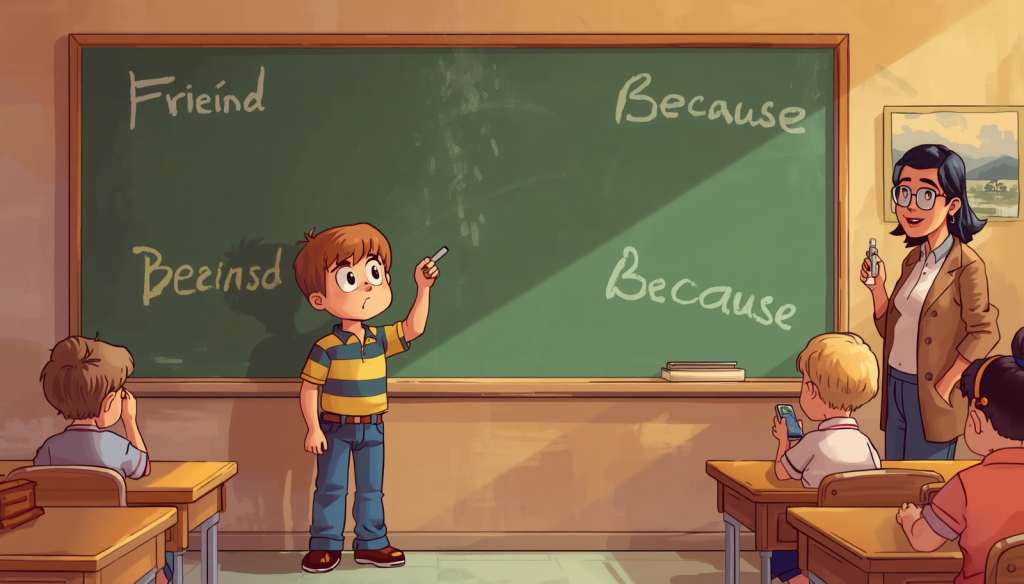
I grew up in the 80’s. I listen to Footloose on the radio every hour while playing Dungeons and Dragons all night in the basement of Ben Davidson’s house. I blared Fear of a Black Planet and Pretty Hate Machine from my Toyota MR2 until I wore out the cassette tapes and had to buy new ones. I won third place in the Epping Junior High break dance competition. I was told by my teachers that I was smart, but I wasn’t applying myself. I was put into occupational therapy when I was in 6th grade because everyone was afraid that I wouldn’t be able to hold down a job. When I wrote on the chalkboard and misspelled a simple word, the class would make fun of me… and so would the teacher. I was never told I had dyslexia, just that I needed to make a better effort.
I felt stupid and confused. When I took tests, it was so stressful I clenched my jaw and twirled my hair around my pointer finger until the hair ripped from my head. I rarely passed. In line, the kids made fun of my bald spot.
College and Shame
When I entered college, I was spelling at a fifth-grade level but had the vocabulary of a college graduate. I didn’t know how to use punctuation beyond a period and a question mark. However, in high school, I earned my black belt in Kempo Karate. Not only was it my first time experiencing success, but it also gave me schemas for success and confidence.
I wrote an essay at the beginning of my Art History course. The paper was returned to me with a big red F in the upper right corner and more words in red pen than I’d used in the whole essay. The ones that hurt the most were, “You should be ashamed. This is far below college-level work.” Those words sat with me. I didn’t have a diagnosis or a reason. What was wrong with me? At this point, I knew I wasn’t dumb. I was suspecting the system had failed me, and I was a freaking black belt. And, as harsh as it was, my professor was right.
F this!
I was early, walking to class from A-lot one day… the most distant parking lot from campus. I walked, and I thought…” below college-level work. Ashamed”
F that!
I rerouted and walked into the college bookstore. There must be something here that can help. The system couldn’t teach me, but I’m different now. I’m confident, resolved, and I keep fighting when people bigger and badder than me are punching me in the face. I bought six books that day on grammar and spelling. Then I spent the first half hour every morning practicing spelling and learning grammar, my way. When I wrote, I would have my best friend and fantastic writer Mark Lingenfelter (“Finger”… long story,) critique it, and I would rewrite it.
The semester was coming to an end. My Art History professor was a published author, so of course, our final included another paper. Was I confident? Hell, no.
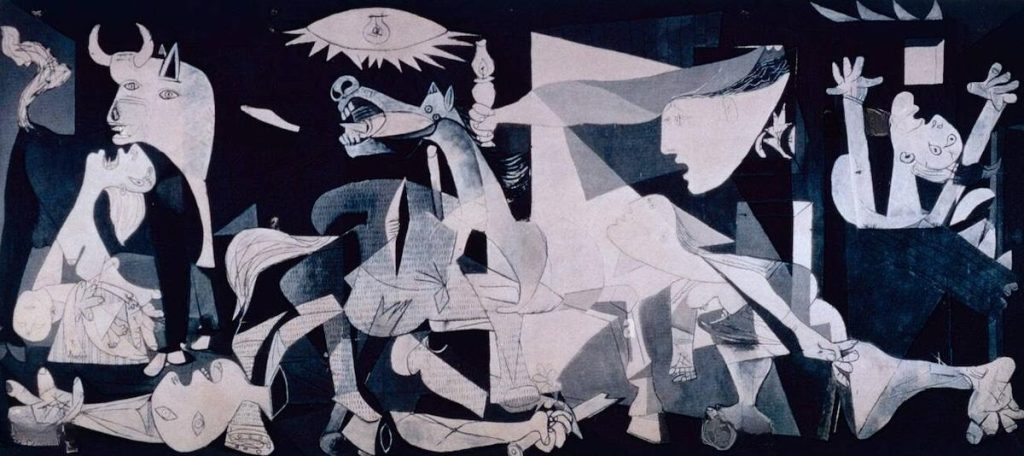
I wrote about Picasso’s Guernica, a 1937 painting, oil on canvas, that was one of the great products of Cubism. It is an anti-war painting in response to the April 29th bombing of Guernica, a town in the Basque Country in northern Spain. It was fun to write, and to this day I love that painting, and to this day writing is fun.
When my professor handed me back my essay, there was, again, red ink. This time, the letter in the upper right was an A. “What a wonderful swansong for the end of the semester,” she had written to close out her remarks. It’s not just that I had done it. Now I knew it could do it.
A Professional Without a Diagnosis
I continued to struggle with anything academic. It carried over into my professional life. But now it was a matter of what I had to overcome and not what I couldn’t do or how stupid I was. What I still didn’t have was a diagnosis. Nowhere was dyslexia in the discussion.
As technology improved, I had more ways to accommodate my atrocious spelling, and it became less of a hindrance… (but still don’t ask me to write on the board in front of people.) After I graduated, Mark Lingenfelter and I published a local magazine covering art, theatre, literature, and music in our area. I wrote a monthly piece on art and developed a following.
That eventually led to a career in technology. While in technology, I was diagnosed, as an adult, with ADD. After learning about digital accessibility from a friend, I spent three years looking for a way into the field. I finally got my shot with Interactive Accessibility in 2013. I started to become intimately familiar with the concept of accommodating.

Two things were happening at the same time. I continued to explore my brain, and I continued to learn about accessibility and the people it benefited. I found my home, and I was happy. My awareness was growing, but was not quite to the point where I understood how accommodation would serve me, how to truly take control of my environment, and ensure it didn’t disable me. The embarrassment was not gone. In fact, in some ways, it was getting worse. I really cared about the work I was doing, so it stung a little worse when people would get frustrated with my writing mistakes and reading misconceptions.
I would send my work to a colleague to proofread, and I would hear, “It should be better than this by the time it gets to me. You need to look it over. Read it out loud to yourself.”
F that.
I still didn’t realize I had dyslexia, but one day I reviewed a product called Ghotit for a blog post. It was great. I started using it. A few years later, I listened to a Stuff You Should Know podcast on dyslexia, How Dyslexia Works. Not on purpose. It was just the next one in the rotation. It sounded like me. I had thought of dyslexia as cartoon letters that jumped around and switched places. That’s how I’d seen it represented. However, Josh and Chuck explained it so well, and what they explained was what I’d been going through my whole life.
I had dyslexia.

Accommodating
I consumed everything I could on dyslexia. I learned that I had a disability, but that dyslexia was also responsible for some of the unique ways my brain worked. Ways that had been a big part of my success. I learned that I will never be a good speller. It’s like trying to pour sixteen ounces of water into an eight-ounce glass. I needed to accommodate. Not that I hadn’t been. I’d been stumbling into ways to cover up my deficiencies for years. Now I had to do it with intent. Ghotit was great, but I needed more.
I was in a world of screen readers. And, for me, I couldn’t see my mistakes when I proofread, but I could hear them. I became a sighted screen reader user, and my world changed. I’m by no means perfect, but most people are surprised when they find out I have dyslexia for the first time. Now I create a reading and writing environment that doesn’t disable me. I also disclose my dyslexia freely. I still have challenges, but they’re minor in comparison.
What does GAAD mean to me?
It means a lot of things. One of those things is that the second A can have a different focus. One that points inward. One that highlights the importance of understanding and admitting that you have a disability and that you should accommodate for that disability. If you don’t have a disability today, and you’re one of the lucky ones, you will have a disability one day. Will you recognize it?
Will you recognize it? Will you accommodate? Like many, will you be too proud and hold out only to struggle? Only you can answer, but when the next GAAD day rolls around, don’t just think of awareness as awareness of the need for digital accessibility; turn it inward. Maybe there is something you can do to improve things for yourself.
The technologies I use to accommodate my Dyslexia
Helperbird Accessibility Tool
There are a lot of features I use. I summarize articles and listen to the summary all the time. Reading and listening at the same time is a big comprehension bump for me.
NVDA
When you just need a screen reader.
Grammarly
This saves me all the time. I love that it kicks in on web forms and places you traditionally wouldn’t have spell check.
Read Aloud in MS Word and Outlook
Found in the review tab of Word and the classic version of Outlook, Read Aloud not only allows you to hear emails sent to you, but you can also listen to what you’ve written. The new Outlook does not have the ability to listen to what you write. The only reason I’m still on Classic is for this feature.
Ghotit Real Writer & Reader
Ghotit Software and Apps were designed and developed for dyslexics and/or dysgraphics in order to help them gain their writing and reading independence.
My Video Review of Ghotit from 2014
Notice my use of the pronoun “them” when referring to who the tool is for. When I made this video, I didn’t know I had dyslexia, although I describe my struggles, which describe the dyslexic experience.

Mark SMiller is a digital accessibility consultant who helps organizations build accessible, inclusive digital experiences. He speaks regularly at industry conferences,, CSUN, CVENt and apperes on many webinars and podace. , He trains teams on practical, sustainable accessibility workflows.
Comments