
TL;DR
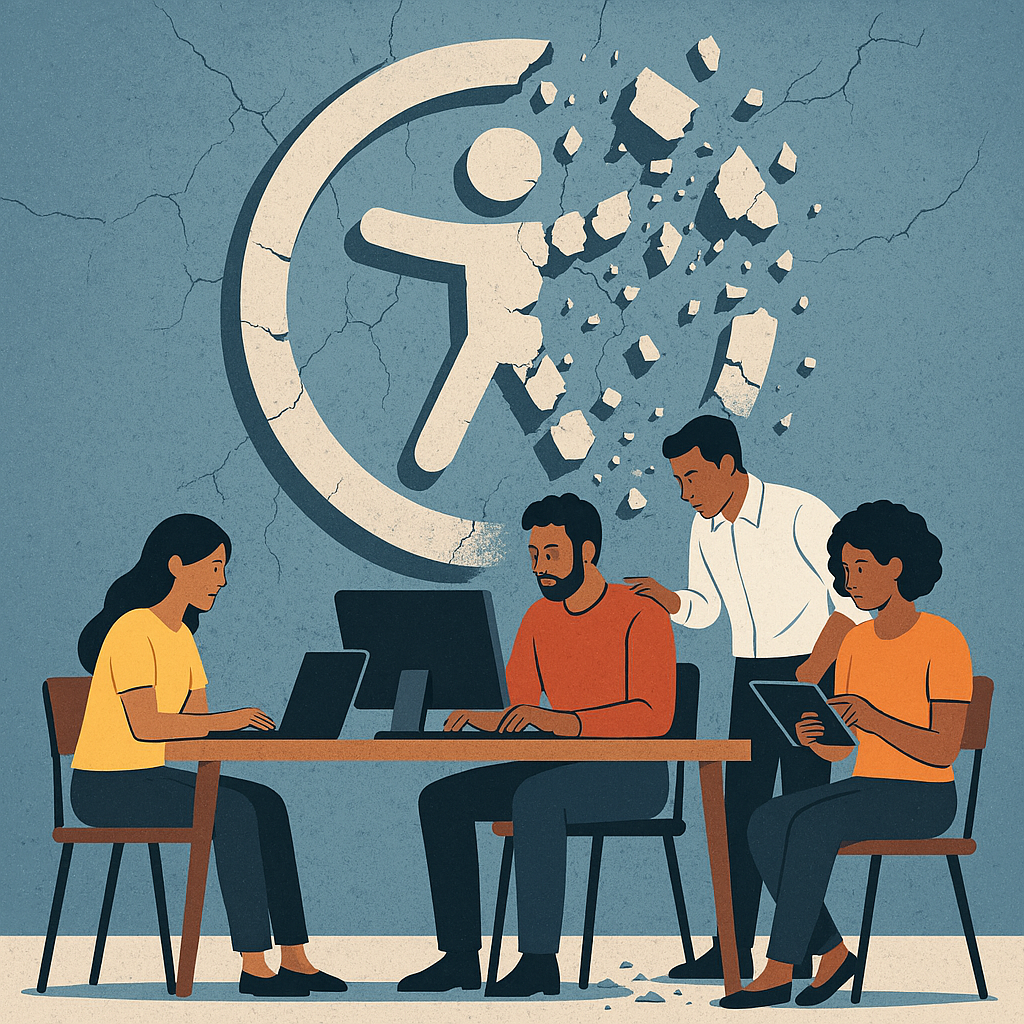
Most organizations start accessibility efforts for a single reason—usually compliance, altruism, or ROI—and those efforts eventually stall because the motivation never evolves. Just like a gym membership that fizzles when the initial goal fades, accessibility collapses when the organization stays zoomed in on one narrow purpose.
Sustainable accessibility only happens when organizations zoom out and adopt a Unified Model of Digital Access that blends compliance (risk reduction), altruism (inclusive experience), and ROI (business value). When all three models work together, accessibility becomes stable, strategic, and self‑sustaining—benefiting employees, customers, and the business itself.
Related Blog Posts
- Legal/Compliance Organizational Model of Digital Access
- Altruistic Organizational Model of Digital Access
- ROI Organizational Model of Digital Access
Why Accessibility Efforts Falter
Why do so many organizations start accessibility efforts only to have them fizzle out? I’ve been working with organizations on accessibility strategy for over a decade and have seen that when organizations initially approach digital accessibility, they do it for a specific reason. If the organization never evolves beyond its initial reasoning, accessibility falters, which is, unfortunately, what usually happens.
The Zoom Lens
Many other factors may contribute to the struggle, but once an accessibility effort is initiated, if the organization doesn’t zoom out and consider all the reasons why accessibility is important, it will ultimately stall and need to be restarted at some point.
Joining the Gym
It’s like joining the gym on January 1st because you want to get in shape for your Caribbean vacation in March. You’re probably still paying for the membership in June, but working out is as much of a memory as the warm Caribbean sun. However, if after a few weeks, you step back and realize you feel better, are becoming more capable, and benefiting from socializing with new friends – in other words, your reason for having a gym membership has evolved – you’re much more likely to maintain a good fitness routine.
To further understand why digital accessibility doesn’t sustain, we need to look at the reasons organizations initiate an accessibility effort. We can think of those reasons as Organizational Models of Digital Access. However, before we get into the organization, let’s flip the coin over and consider the people who benefit from accessibility.
Mature your Organization’s Accessibility Capability
Learn how IIA can help you with an accessibility strategy to create efficiency, capability, ROI, and the W3C Accessibility Maturity Model.
People
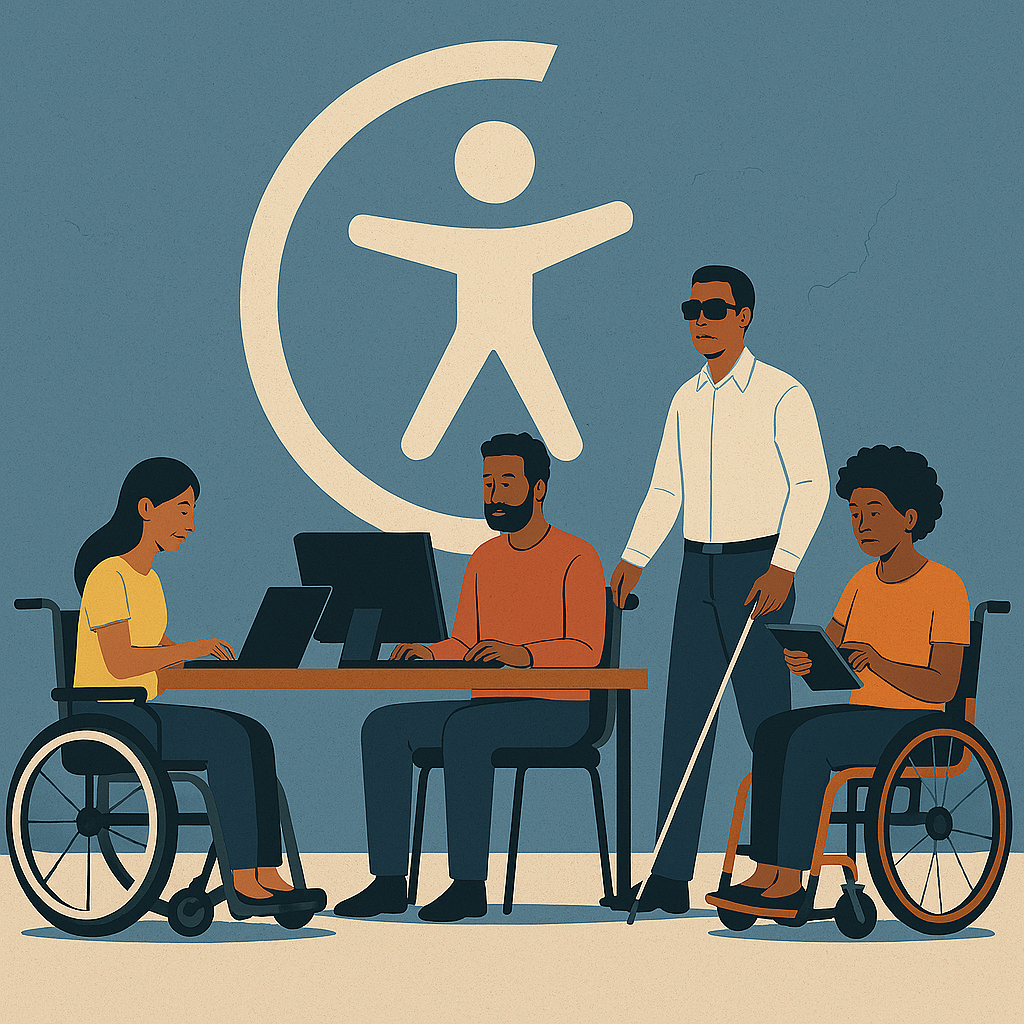
People are the heart of any business, and every business has two hearts. The people who run the business and the people who are customers of the business. As we’ll discuss, people with disabilities are a significant part of both of those hearts. Like any group of people, if we don’t think of them in the right way, it’s damaging to the heart. Fortunately, we have frameworks to help us understand, as a business, how to approach and consider this group. These are the models of disability, and they describe the perspective from which people with disabilities are approached.
Models of Disability
- Medical Model: This model views disability as a condition located within the individual. The primary focus is placed on cure, fixing the condition, or diagnosis. It is often criticized because it overlooks systemic barriers and tends to marginalize people.
- Charity Model: Considered an outdated approach, this model views disabled people as passive recipients of pity or care. It is rejected in modern inclusion efforts because it reinforces dependency.
- Economic Model: This model focuses primarily on the financial cost of disability to individuals or society. While it often guides policy decisions, it can dehumanize the individual by focusing exclusively on expense or productivity.
- Human Rights Model: This approach treats disability as a social and political issue connected to equality, dignity, and inclusion. It aligns closely with the social model but explicitly links disability to civil rights and legal protections, forming the basis of anti-discrimination laws and international treaties.
- Social Model: This model defines disability as the result of environments (which can be digital, social, or physical) that fail to accommodate the full range of human diversity. According to the social model, exclusion happens because of the way systems are designed, not because of the person’s body or mind. This is the model widely used in accessibility work and is embraced by the United Nations Convention on the Rights of Persons with Disabilities (CRPD). Disability, in this context, arises from the interaction between a person’s capabilities and the barriers created by their environment.
Focusing the Lens
As you can see, each model is like a lens that focuses on a particular aspect of disability. That focus can be appropriate or inappropriate depending on perspective. If you’re a physician working with a patient, the Medical Model is perfectly appropriate. However, if you are a business trying to serve the community, the notion of “fixing” your customers (or that your customers need to be fixed) is completely inappropriate. That is between them and their physician. Businesses, on the other hand, focus on creating environments in which their customers can do business with them or consume content about the organization. The social model approaches disability from this perspective and focuses us on creating environments in which all people, regardless of ability, can operate.
Organizations
If we flip the coin back over and look at why organizations choose to include access for people with disabilities in the environments they create, there are three Models of Organizational Digital Accessibility to consider. Like the Models of Disability, the Organizational Models of Digital Access are like lenses that focus the business in a specific direction. This is clear when we look at the three models. Here are short explanations of each model that are linked to blog posts that explain each model in more depth:
Organizational Models of Digital Access
- Legal/Compliance Organizational Model of Digital Access: This looks at accessibility from the regulatory standpoint. An organization enters into this model to mitigate legal risk, manage legal complaints, and comply with government regulations. Accessibility doesn’t sustain under this model when the legal action is resolved, and priorities shift elsewhere.
- Altruistic Organizational Model of Digital Access: This model considers accessibility to be a part of the organization’s ethics or social responsibility. It focuses heavily on the usability of digital assets and ensuring inclusivity. Accessibility doesn’t sustain under this model when business priorities like timing and revenue override what is perceived as a nice-to-have.
- ROI Organizational Model of Digital Access: Considers the return on investment that including people with disabilities brings. Accessibility doesn’t sustain under this model when leadership lacks confidence in the data, or there is a lack of data, demonstrating the return.



Each one of these models is important and brings value to the organization and to the organization’s clients with disabilities. They also each have their challenges as noted above. Therefore, when an organization focuses on just one, it’s brittle and difficult to sustain accessibility.
The Unified Organizational Model of Digital Access
If these models are lenses that focus the business, how should the business focus to give it the best chance to maintain accessibility, create efficiency, and enhance the overall benefits to both the business and the public it serves? Understanding that the focus of each model above is too narrow to maintain, we can conclude that the focus needs to be widened.

Zooming Out
This brings us to the Unified Model of Organizational Access, which brings together all three models and their supporting factors. When an organization zooms out far enough to see all three models unified, the full benefits of accessibility are more than enough to support a significant and sustained focus from the business.
Why is the Unified Model important? How does it help us as employees, leaders, and customers? Because it helps us evangelize. Many businesses are wasting money and resources on ad hoc accessibility efforts that fall by the wayside. Understanding all the ways that accessibility supports the business motivates them to build sustainable and beneficial practices. When businesses create consistent experiences for their customers with disabilities, the elderly, and everyone else who experiences life challenges, the impact extends from the business into the community.
How the Models Support Each Other
- The monetary and resource costs of the Compliance Model are offset by the return of the ROI Model.
- The difficulty in maintaining the priority of the Altruistic model is overridden by the strong business cases of the Compliance and ROI models
- The shift in priority when matters are temporarily handled in the Compliance Model is smoothed out by the ongoing returns of the ROI Model and the customer satisfaction of the Altruistic Model.
- The gains from the ROI model and the savings from the compliance model justify additional staffing to support accessibility efforts.
It’s also at this point that the idea of ongoing accessibility becomes appealing to leadership, and the Shift Left ROI model becomes an appealing way to increase overall ROI.
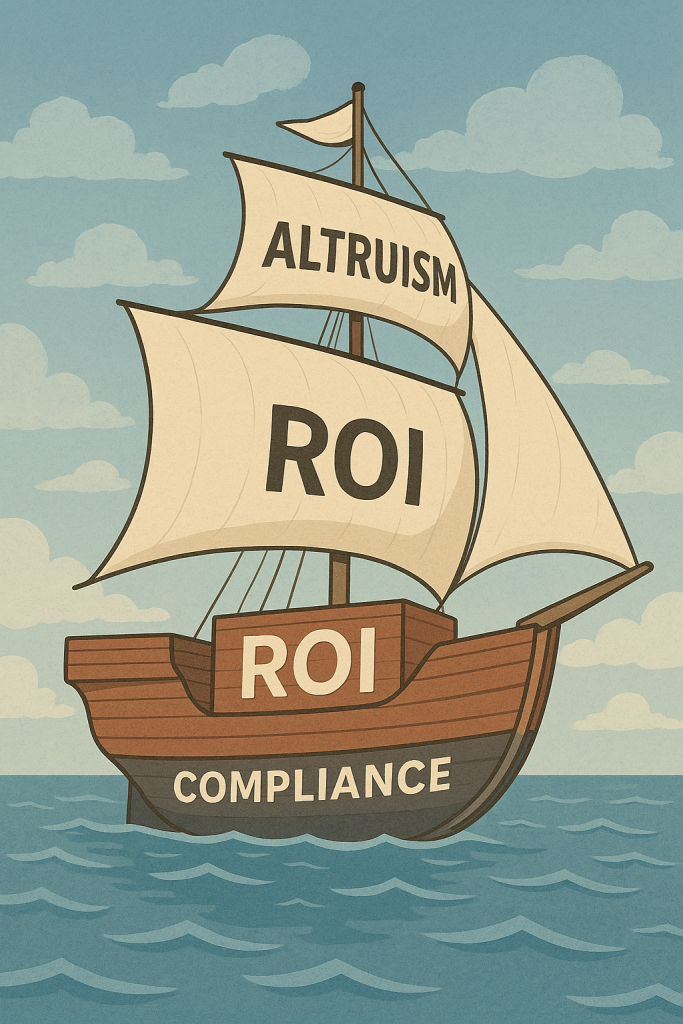
You can think of organizational accessibility as a ship where all three models combine and create a balance. ROI is the cargo hold, compliance is the keel, and altruism is the wind in the sales. The combination gives the ship purpose, direction, and drive.
We’ve discussed in detail why accessibility is important and how organizations can consider accessibility in a way that focuses them on all of its benefits. Now you’re probably wondering how to implement the capabilities within an organization. For that, check out the W3C Accessibility Maturity Model Explained blog.

Mark SMiller is a digital accessibility consultant who helps organizations build accessible, inclusive digital experiences. He speaks regularly at industry conferences,, CSUN, CVENt and apperes on many webinars and podace. , He trains teams on practical, sustainable accessibility workflows.
Comments